
Lessons Learned from the Vancouver Rat Project
From Data to Knowledge to Wisdom: Lessons Learned from the Vancouver Rat Project
Himsworth CG and Byers KA. 2026. Integrative Zoology
https://doi.org/10.1111/1749-4877.70125
Over the past 15 years, the Vancouver Rat Project has been striving to understand, monitor, and manage urban rats and rat-related impacts to human health and wellbeing in North American cities. One of the key things this interdisciplinary research has shown is that, while research has traditionally focused on the individual components of the ‘rat problem,’ rat-related harms are created, magnified, or mitigated at the interfaces among rats, people, and the environment. Similarly, though each scientific discipline can provide data to help characterize, monitor, and mitigate rat-associated harms, it is the interface between these disciplines from which the knowledge to solve current rat problems emerges, and from which we can create the wisdom needed to predict and prevent future issues. This review describes how we combined epidemiology, ecology, pathology, pathogen genomics, population genetics, policy analysis, social sciences and more, to change the way we assess, monitor, and mitigate diverse risks associated with urban rats.
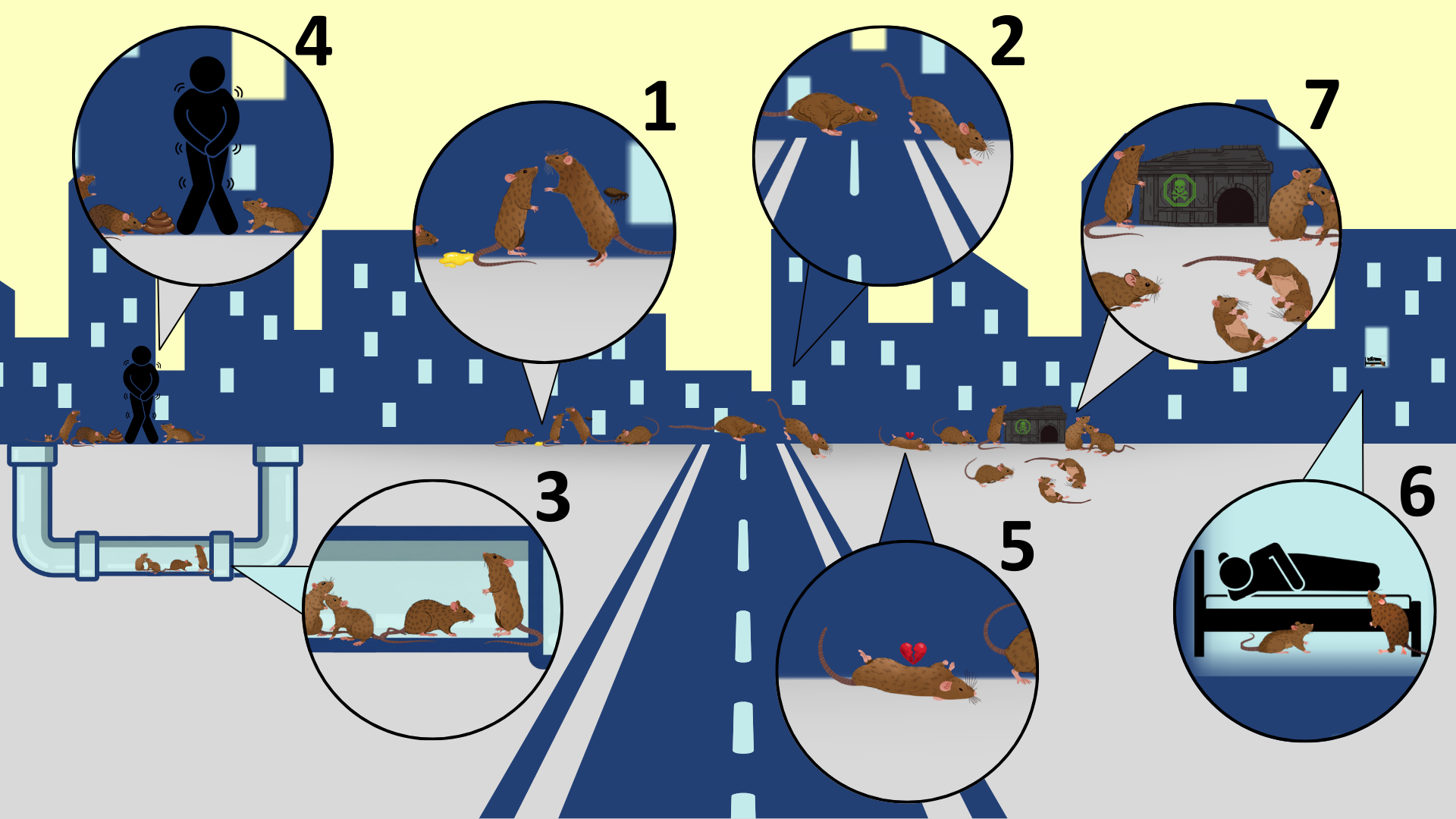
A synthesis of 15 years of research conducted by the Vancouver Rat Project revealed that: 1) Pathogen ecology within rat colonies is the result of complex interactions among rats, pathogens, and vectors. 2) Local and global population structures influence rat and pathogen ecology. 3) Fine scale features of the urban environment can impact rat and pathogen control. 4) Rats can carry a variety of pathogens normally found in other species, including humans. 5) The things that make people sick do not make rats sick and vice versa. 6) There is more to the potential impact of rats on human health and wellbeing than zoonoses. 7) Municipal rat management approaches based on a “War on Rats” paradigm are unlikely to be successful.